

Welcome to Solomon!

Enter the Access Code below

Access code is invalid

Solomon Logo

Versions Compared

Key

  • This line was added.
  • This line was removed.
  • Formatting was changed.

Understanding the International Salary Structure

Reliant recognizes that international workers face unique financial realities:

  • Cost of living varies widely across cities.
  • Job roles and responsibilities differ.
  • Even while living abroad, you're still planning for things like retirement and college savings.

Two Common Salary Models

Most employers use one of two approaches:

  • Needs-based salary: Based on your family’s financial needs in your location.
  • Market-based salary: Based on the job itself, regardless of personal needs.

Reliant uses a hybrid model that combines both.

How Reliant’s Hybrid Model Works

We create a recommended household budget that considers:

  • Your family situation
  • Your location’s cost of living
  • Your role and tenure

This helps determine a maximum salary that’s fair and sustainable.

Info

Note: This is not a required salary. It’s a helpful starting point to reduce guesswork and ensure consistency across international roles.


Why This Matters

Our goal is to help you thrive in your ministry location while maintaining equitable compensation across

the organization

Reliant.

Next: The following page explains how we calculate your monthly salary.


Info

Reminder: This section only covers your salary. Your support goal also includes ministry expenses, benefits, and administrative

fees.

For international employees, we recognize that there is a vast difference in cost of living across the international cities where our workers live and minister. We recognize that workers have varying job roles and responsibilities that are worthy of unique compensation. We also recognize that while you will live in a different country, you are still an American that will need to retire, send kids to college, etc.

There are two types of salary structures that most employers utilize. One is a needs-based salary, by which you calculate your overall needs within the area you are going to work for the entirety of your family. The other is a market-based salary by which you are simply paid for the work you do regardless of family situation or needs. The majority of jobs in America are a market-based salary. Missions agencies and some other institutions utilize the needs-based salary. There are positives and negatives to both avenues. We won’t get into those at this time, but our team is happy to dialogue with you if desired. 

We have developed a hybrid of the two whereby we assess provide your needs based on your family dynamic and location, while taking into consideration tenure and role to provide a “recommended household budget.” This provides for you a max salary that is equitable to the role and tenure of your job, but also considers the cost of living in your city and your family dynamic.

Keep in mind that this is not a required salary, but rather is a way to take the guesswork out of determining the needs based salary that Reliant International Workers have traditionally had to determine on their own. 

Reliant International’s salary structure balances these realities in a way that we believe will ensure all our workers have what they need to thrive in their specific locations and uphold equitable compensation metrics.

The following page will guide you through how we determine your monthly salary.

Note: This is only relating to your actual salary. Your support goal, which includes ministry expenses, benefits, and admin

fees

, is the total amount per month that you will need to raise

.


Determining Your Monthly Salary

For international workers, we are utilize use the same Reliant US U.S. staff salary levels as our starting point. In collaboration Together with your supervisor, we will we’ll determine what the appropriate job level is appropriate for your position and where on the you fall within that salary range for that level makes sense based on your tenure and performance. This number provides gives us a starting placebaseline, whereby we will make adjustments based on which we then adjust according to the cost of living in the location that you are serving inyour ministry location.

To make the adjustment to a comparable salary in the location a Reliant international worker is serving, we are going to break the appropriate US Reliant Salary into 3 segments and make adjustments accordingly: determine a fair and comparable salary for international workers, we start with the appropriate U.S. Reliant salary level. Then, we break that salary into three segments and adjust each one based on the cost of living in your ministry location.

UI Steps
sizesmall


UI Step

Segment 1: U.S. Base Salary

This portion of your salary is based on Reliant’s U.S. staff levels and remains the same regardless of where you serve internationally. It reflects shared financial realities for American workers—such as saving for retirement, college, and other long-term needs—that apply no matter your location

The first ⅓ is the US base salary. This segment will be the same for someone in an expensive context vs a less expensive context. This segment factors in that no matter where you live there are aspects of being an American that will be the same across the board

.


UI Step

The second ⅓ is the cost of living adjustmentSegment #2: Cost of Living Adjustment (COLA).

We take

one-third of your base salary and

multiply by

adjust it using a COLA percentage. This

segment will be considerably higher for someone going to an expensive context and considerably lower for someone going to a less expensive location. This number is based on 3 cost of living websites that we average out and then round up

adjustment reflects the cost of living in your ministry location—higher for expensive cities, lower for more affordable ones. The COLA percentage is based on an average from three cost-of-living websites, and we round the final number up to ensure adequate coverage.


UI Step

Segment #3: Housing and Utilities

This portion of your salary is based on the real The last ⅓ is for the actual cost of housing and utilities that the Intl Worker will be paying. This in your ministry location. It helps account for drastic significant differences in housing differences expenses across locations regions and reflects the differing unique needs of a each family unit. This is also in line with the approach aligns with typical American budget, in which Housing is 30-35% of an American’s budgetbudgeting, where housing costs generally make up 30–35% of monthly expenses.

Examples:


  1. In the first column you see the ⅓ categories.
  2. In the second column you can see the breakdown of those 3 categories for the US salary (annually).
  3. In the third column you see an example of Vietnam, which has a lower cost of living than the US:
    1. US Base ⅓ Segment - On the first line you see that their US salary base segment of the salary is the same, because this will stay the same no matter where they are in the world.
    2. Cost of Living Adjustment ⅓ Segment - In the second line you see the cost of living adjustment segment. Vietnam is a 50% COLA adjustment, so instead of that being $833 it’s $417 for this segment.
    3. Housing ⅓ Segment - In the third line you see the actual housing cost segment. In Vietnam, housing is oddly expensive, so it’s $1,000 for this segment instead of $833. 
  4. In the fourth column you see an example of Japan, one of the more expensive countries we work in.
    1. On the first line you see that their US salary base segment of the salary is the same, because this will stay the same no matter where they are in the world.
    2. In the second line you see the cost of living adjustment segment. Japan is a 150% COLA adjustment, so instead of that being $833 it’s a $1,250 for this segment.
    3. In the third line you see the actual housing cost segment. In Japan, the actual housing cost is $1,250, so for this segment we are putting $1,250 towards salary instead of $833 as we would in the US.
All this comes to a different total for each location. Same type of person, same tenure, same type of job, but different total because of the Cost of Living and housing costs in that actual location

Each location results in a different total salary—even for workers with the same role, tenure, and family situation—because of differences in cost of living and housing expenses.

UI Expand
titleA Single Worker Living Overseas

So let’s Let’s look at an example of a new Reliant International Worker, who is single, and has an overseas job that is equivalent to a Reliant US Worker that U.S. worker who would make $30,000/year or $2,500/monthly in the USU.S. The table shows the monthly salary breakdown. Below the table you’ll see an explanation of each column and line:


Single PersonUS Salary
US
(100% COLA)

Vietnam Salary
(50% COLA)

Japan
(150% COLA)

Segment #1: US Base

$833

$833

$833

Segment #2: COLA

$833

$417

$1,250

Segment #3: Housing

$833

$1,000

$1,250

Total Gross Salary

$2,500

$2,250

$3,333

UI Expand
titleBreakdown of the Chart


UI Expand
titleA Married Couple living Overseas

For a married couples, we determine a household salary, based on individual staff levels, COLA, and joint housing costs. In Table 2, Spouse 1 would make $36,000 in the US based on staff level and Spouse 2 would make $54,000 in the US based on staff level. This is a combined annual salary of 90$90,000, or $7500 $7,500 per month.

UI Expand
titleTable 2 - Total Household Salary


Household Salary
Total

US Salary
(100% COLA) 

Vietnam Salary
(50% COLA)

Japan Salary
(150% COLA)

Segment #1: US Base

$2,500

$2,500

$2,500

Segment #2: COLA

$2,500

$1,250

$3,750

Segment #3: Housing

$2,500

$2,000

$3,000

TotalsTotal Gross Salaries

$7,500

$5,750

$9,250

We

will

typically divide the household salary based on each spouse’s staff level. If both

spouses

are at the same level,

the split is

it’s a 50/50

.In this case, Spouse 1's staff level accounts for 40% of the base salary, and Spouse 2's staff level accounts for 60%. Their salary would be split 40/60. If they were living

split. If one spouse’s role accounts for more of the salary—say 40/60—the split reflects that. For example, in Japan, Spouse 1

would

might receive

$3700

$3,700 and Spouse 2

would receive

$5,550.

We’re also happy to adjust the percentage split if needed—just let us know. Some couples choose a different breakdown for tax reasons or other personal preferences.


Adding Auxiliary Monthly Expenses

UI Steps
sizesmall


UI Step

Children's Education/Childcare - You may take a stipend equal to the actual cost of enrolling your children in school, homeschooling your children overseas, or obtaining childcare in order for both spouses to fulfill ministry responsibilities. Because this is not eligible as a reimbursement, we must include it in your salary. 


UI Step

Special Medical Allowance - For ongoing medical or mental health needs, you may include a monthly amount to offset the cost, especially if costs are increased as a result of an overseas assignment.


UI Step

Student Loan Payments - Because many of our workers have obtained professional degrees, yet have sacrificed a more profitable career to serve overseas, they may receive an additional amount per month to cover outstanding student loan payments.


UI Step

Local Health Insurance Premium - For workers who serve in a country that offers a national health insurance plan, any associated premiums may be included as an additional salary item. For those on Reliant's health insurance, this premium will be added to your monthly support goal later in the worksheet and will come directly from one’s MTD account, not your salary.


UI Step

Taxes in Country of Service - While most international workers will be exempt from federal income tax, many will owe taxes in the country where they are living an working. You should work with your supervisor to estimate taxes you might owe. If they will be quarterly or annual payments, estimate the cost per month for budgeting purposes.


UI Step

Ministry Expense Bonus - Full-time workers (30+ hours) may take up to $600/month to cover ministry expenses including local travel, meals and hospitality, internet service, and other miscellaneous items. Part-time workers may take up to $300/month.


UI Step

Monthly Cell Phone Bonus - Full-time workers (30+ hours) may take up to $100/month to cover their cell phone bill. This is a separate line item on your paystub and is considered non-taxable income.


Examples
UI Expand
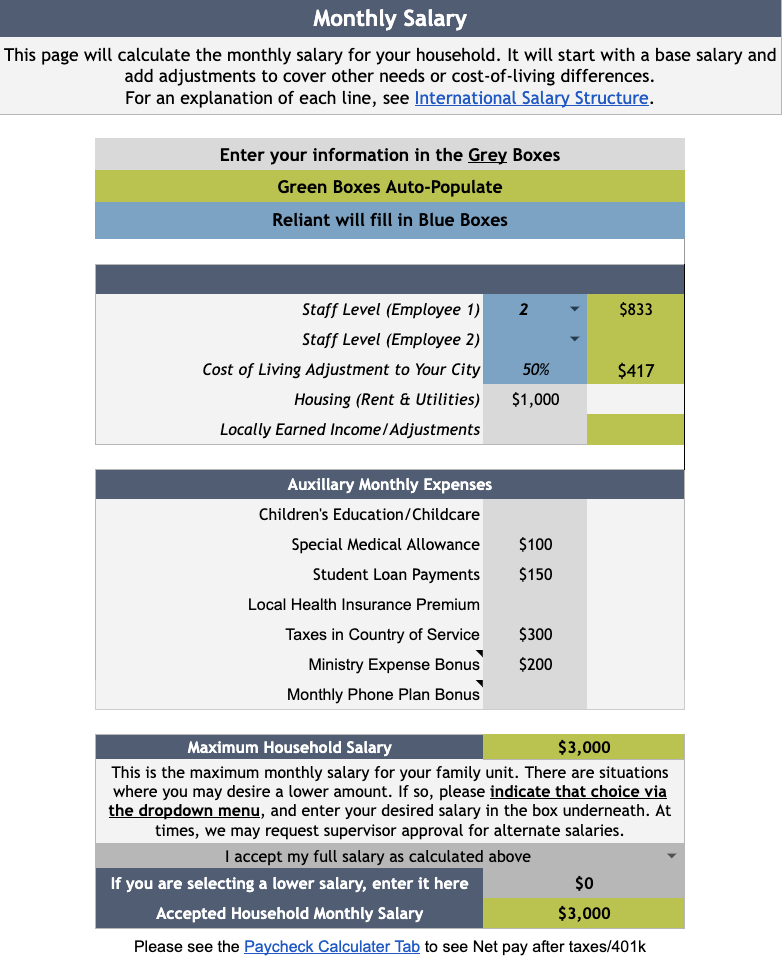
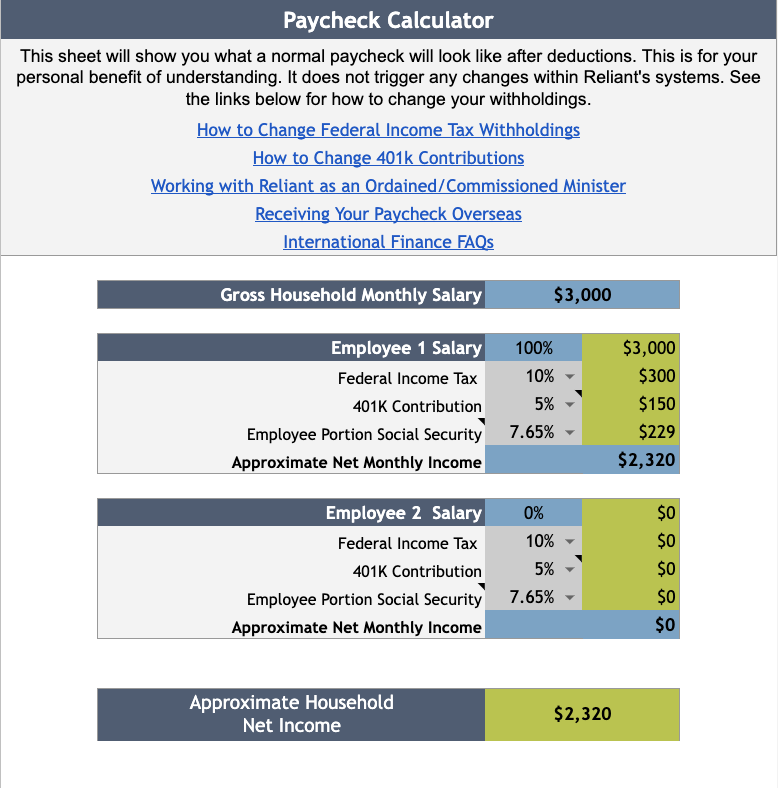
titleA Single Worker living in Vietnam

Based on the above example in Table 1, where the starting monthly salary is $2250

Monthly SalaryChildren EdMedicalStudent LoansLocal HealthTaxes

Ministry Expense Bonus

Gross Monthly Income
$2250NA$100$150NA$300$200$3,000

Click the images below to see how it works out on the spreadsheet.


UI Expand
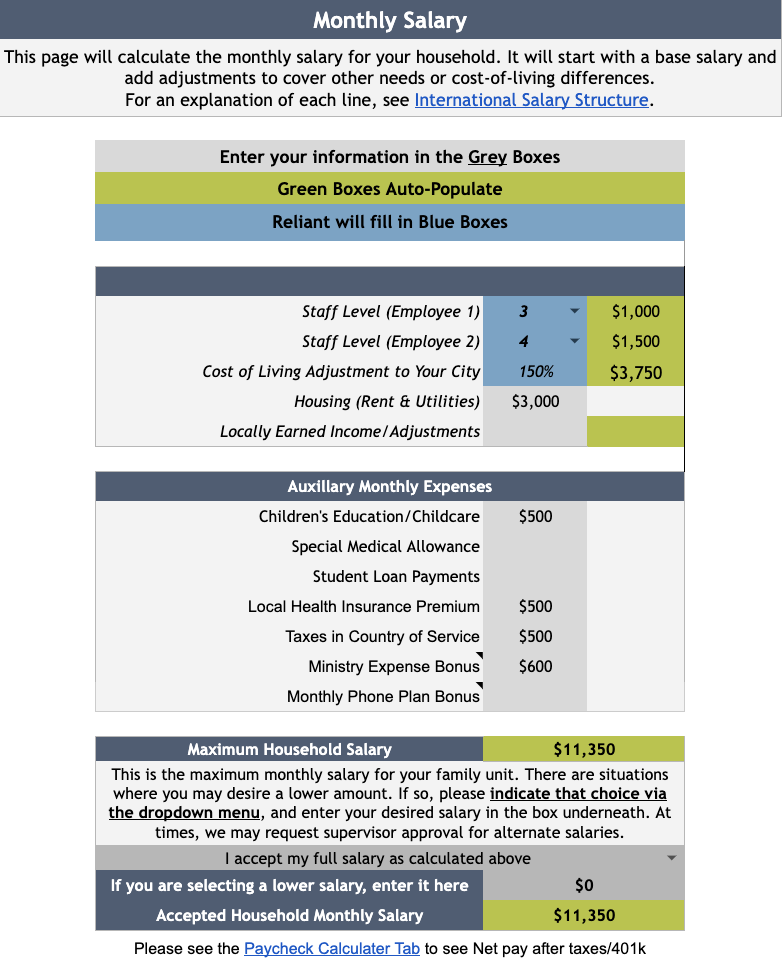
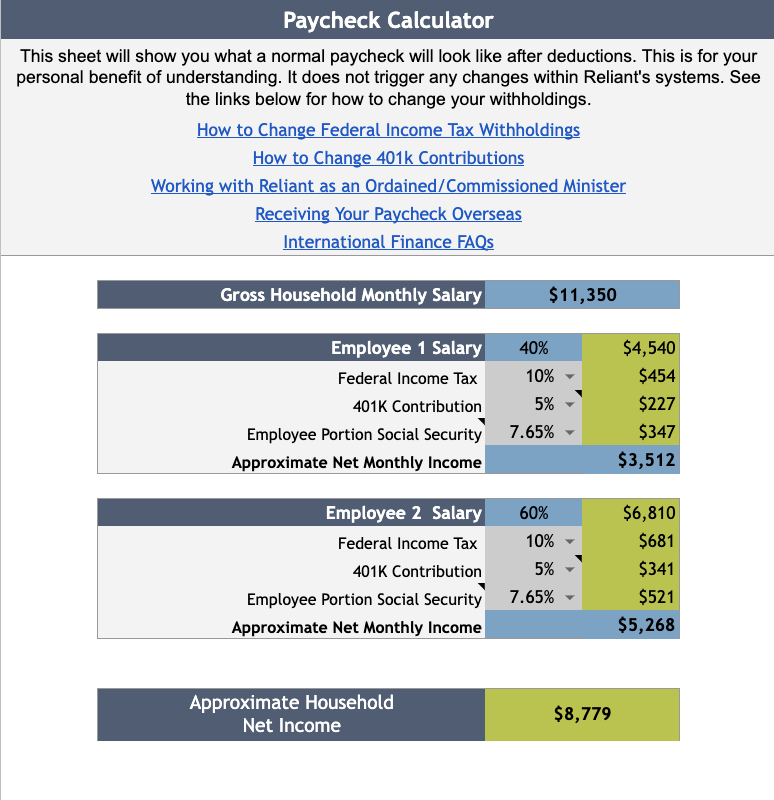
titleMarried Couple living in Japan

Based on the above example in Table 2, where the starting household salary is $9,250/month.

Auxiliary Expenses are divided between each spouse based on portion of total salary.

Total Monthly Salary

Children EdMedicalStudent LoansLocal HealthTaxesMinistry Expense Bonus

Spouse 1 Gross Monthly Income

Spouse 2 Gross Monthly Income

$9,250$500NANA$500$500$600$4,540$6810

Click the images below to see how it works out on the spreadsheet.


Accepting Your Salary

This worksheet calculates the salary that we believe will allow you to thrive on the field, be adequately compensated for your job role, and make provisions for the future. Because all international workers are support-based, we offer you the freedom of accepting a lower salary. The support goal worksheet will default to accepting the total salary. If you want to take a lower salary, please choose that from the dropdown menu and enter a new amount below.

Paycheck Calculator

Please use the tab "Paycheck Calculator" to determine what your Net Pay will be after Federal Tax deductions and 401k Contributions. We have factored these into our Base Salaries and you are responsible for understanding your Tax Withholding. You must update your W-4 to notify Reliant of any changes.