


Understanding the International Salary Structure
International workers face unique financial realities—varying costs of living, diverse job roles, and long-term financial planning needs like retirement and college savings.
| Salary Models | |
|---|---|
| Needs-based | Based on your family’s financial needs in your location. |
| Market-based | Based on the job itself, regardless of personal needs. |
| Reliant's Hybrid Model | We blend both approaches, creating a recommended household budget that considers:
|
This helps determine a maximum salary that’s fair and sustainable. This is not a required salary, but it’s a helpful starting point to reduce guesswork and ensure consistency across international roles.
Reminder: This section only covers your salary. Your support goal also includes ministry expenses, benefits, and administrative fees.
Determining Your Monthly Salary
To determine a fair and comparable salary for international workers, we begin with the appropriate U.S. Reliant salary level based on your job role, tenure, and performance. This serves as our baseline. We then adjust that salary—broken into three segments—according to the cost of living in your ministry location.
Segment #1: U.S. Base Salary
Your base salary is based on Reliant’s U.S. staff levels and remains the same regardless of where you serve internationally. It reflects shared financial realities for American workers—such as saving for retirement, college, and other long-term needs—that apply no matter your location. This will automatically increase by 5% for every year of tenure.
Segment #2: Cost of Living Adjustment (COLA)
We take one-third of your base salary and adjust it using a COLA percentage. This adjustment reflects the cost of living in your ministry location—higher for expensive cities, lower for more affordable ones. The COLA percentage is based on an average from three cost-of-living websites, and we round the final number up to ensure adequate coverage.
Segment #3: Housing and Utilities
This portion of your salary is based on the real cost of housing and utilities in your ministry location. It helps account for significant differences in housing expenses across regions and reflects the unique needs of each family unit. This approach aligns with typical American budgeting, where housing costs generally make up 30–35% of monthly expenses.
Examples:
Adding Auxiliary Monthly Expenses
Children's Education/Childcare - You may take a stipend equal to the actual cost of enrolling your children in school, homeschooling your children overseas, or obtaining childcare in order for both spouses to fulfill ministry responsibilities. Because this is not eligible as a reimbursement, we must include it in your salary.
Student Loan Payments - Because many of our workers have obtained professional degrees, yet have sacrificed a more profitable career to serve overseas, they may receive an additional amount per month to cover outstanding student loan payments.
Local Health Insurance Premium - For workers who serve in a country that offers a national health insurance plan, any associated premiums may be included as an additional salary item. For those on Reliant's health insurance, this premium will be added to your monthly support goal later in the worksheet and will come directly from one’s MTD account, not your salary.
Taxes in Country of Service - While most international workers will be exempt from federal income tax, many will owe taxes in the country where they are living an working. You should work with your supervisor to estimate taxes you might owe. If they will be quarterly or annual payments, estimate the cost per month for budgeting purposes.
Ministry Expense Bonus - Full-time workers (30+ hours) may take up to $600/month to cover ministry expenses including local travel, meals and hospitality, internet service, and other miscellaneous items. Part-time workers may take up to $300/month.
Monthly Cell Phone Bonus - Full-time workers (30+ hours) may take up to $100/month to cover their cell phone bill. This is a separate line item on your paystub and is considered non-taxable income.
Examples
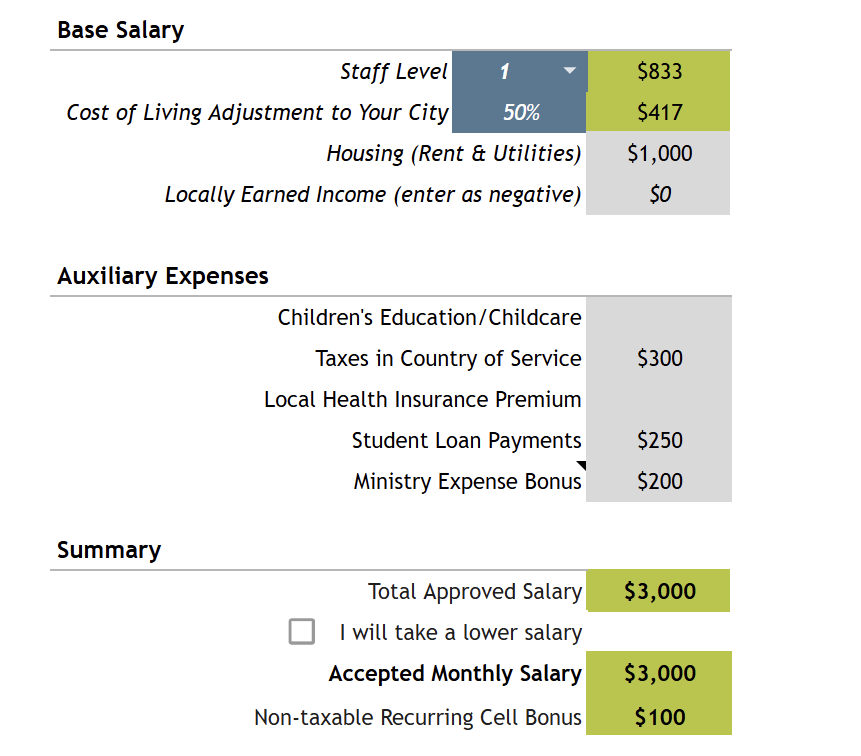
Based on the above example in Table 1, where the starting monthly salary is $2250
| Monthly Salary | Children Ed | Taxes | Local Health | Student Loan Payments | Ministry Expense Bonus | Gross Monthly Income |
|---|---|---|---|---|---|---|
| $2250 | NA | $300 | NA | $250 | $200 | $3,000 |
Click the images below to see how it works out on the spreadsheet.
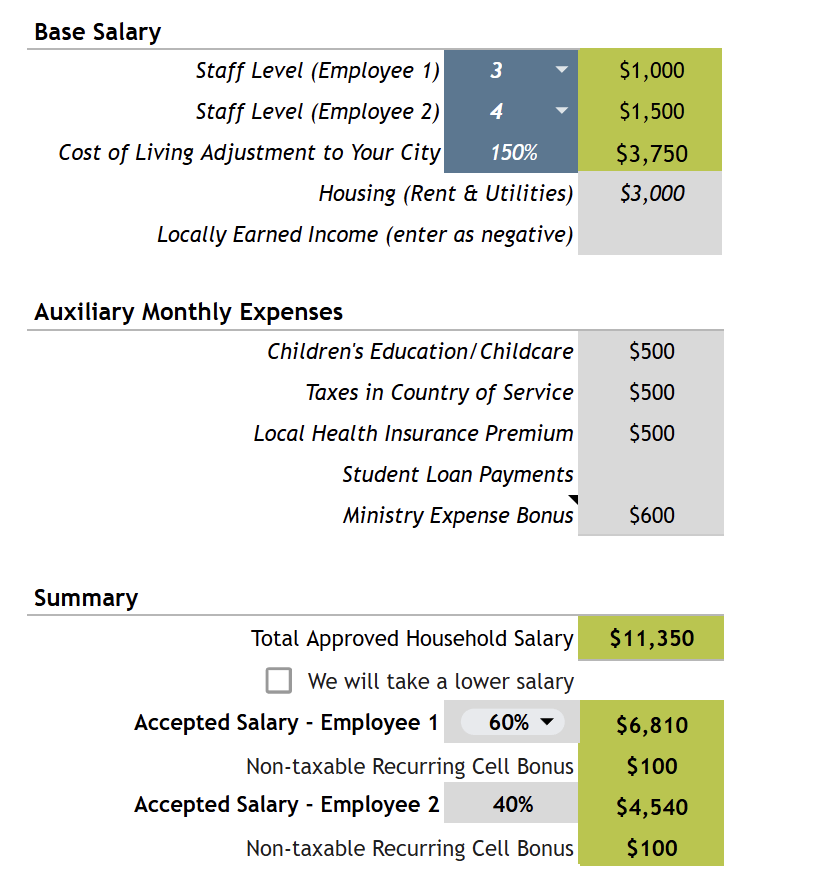
Based on the above example in Table 2, where the starting household salary is $9,250/month.
Auxiliary Expenses are divided between each spouse based on portion of total salary.
Total Monthly Salary | Children Ed | Student Loans | Local Health | Taxes | Ministry Expense Bonus | Spouse 1 Gross Monthly Income | Spouse 2 Gross Monthly Income |
|---|---|---|---|---|---|---|---|
| $9,250 | $500 | NA | $500 | $500 | $600 | $4,540 | $6810 |
Click the images below to see how it works out on the spreadsheet.
Accepting Your Salary
This worksheet calculates the salary that we believe will allow you to thrive on the field, be adequately compensated for your job role, and make provisions for the future. Because all international workers are support-based, we offer you the freedom of accepting a lower salary. The support goal worksheet will default to accepting the total salary. If you want to take a lower salary, check the box next to "I will choose a lower salary" and enter your desired amount.
Paycheck Calculator
Please use the tab "Paycheck Calculator" to determine what your Net Pay will be after Federal Tax deductions and 403b Contributions. We have factored these into our Base Salaries and you are responsible for understanding your Tax Withholding. You must update your W-4 to notify Reliant of any changes.
